
What to post inside a short-term rental
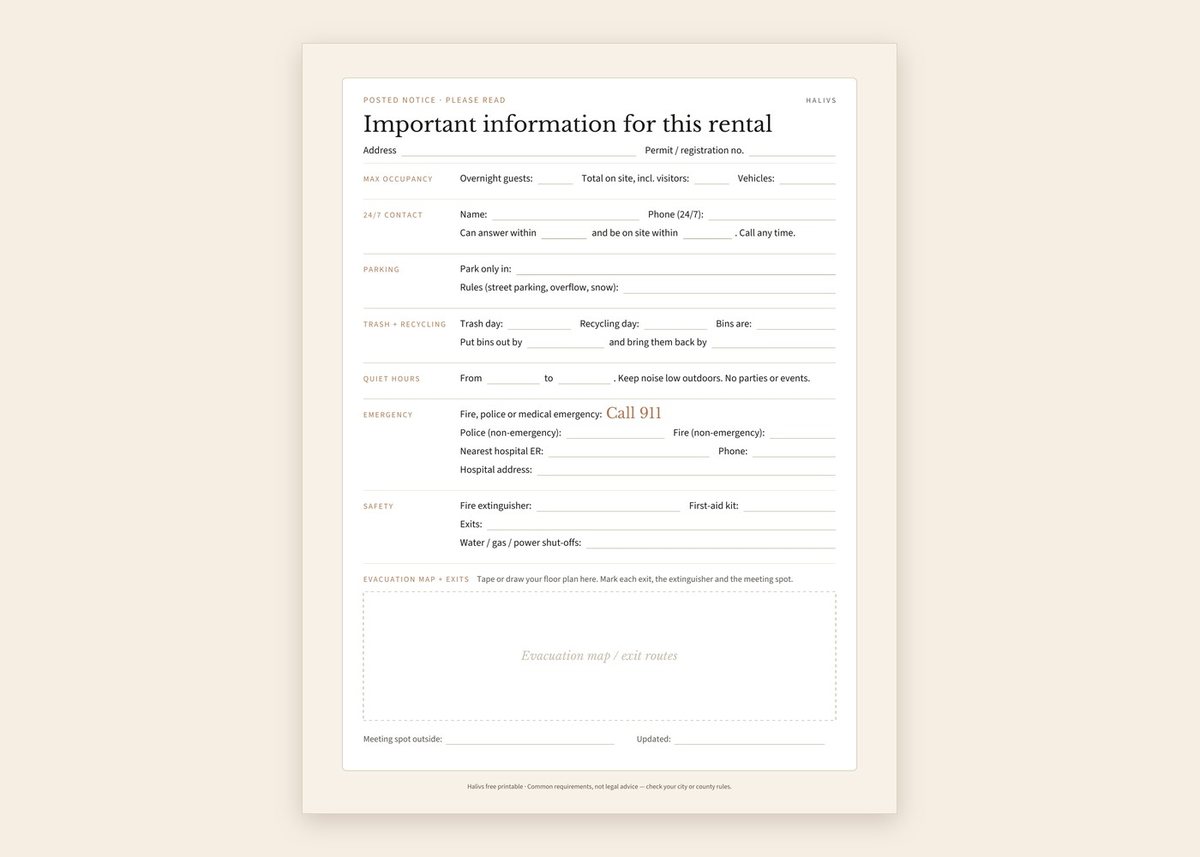
A lot of short-term rental permits come with a sign you have to put up inside the unit. Usually it lists the max occupancy, a local contact who answers 24/7, where to park, trash day, quiet hours, emergency numbers and an evacuation map. Guests mostly read it once. It matters on the night something goes wrong, and when an inspector or a neighbor asks whether you have one.
By Halivs · Updated October 23, 2026
Two real examples
Rules vary a lot from place to place, so it helps to look at what two counties actually publish.
San Bernardino County, California. The county’s STR Operational Standard Guide has a section called “Posted Notices within Unit.” The evacuation map and a copy of the STR permit go on or next to the front door. Inside, the county lists the address, the managing agent with a 24/7 phone number, the max number of overnight occupants, the parking areas, a snow removal contact, trash instructions, a disturbing-the-peace notice, where the utility shut-offs are, emergency medical and law enforcement numbers, and a map of the property boundaries. The guide also expects the owner or agent to answer within 30 minutes and be on site within an hour, sets quiet hours from 10 pm to 7 am, and does not allow street parking.
Walton County, Florida. Walton goes further and publishes internal posting templates: you replace the red text with your own details. They cover the property name, address and certificate number, the local responsible party, max occupancy (set by the State Fire Marshal at 150 square feet per person), the noise ordinance (10 pm to 6 am, fines up to $500), on-site parking with a sketch, trash and recycling days, the nearest emergency room and evacuation guidance.
Different counties, same core list. That list is what the free notice is built around.
The checklist
Use this to check your own notice, whatever template you use. Fill in real values, not placeholders.
- Address and permit number. The full street address (what you would tell a 911 dispatcher) and your STR permit or registration number.
- Max occupancy. Overnight guests, the total allowed on site, and how many vehicles. Use the numbers on your permit, and make them match the listing.
- 24/7 local contact. A name and a phone number that is answered at night, plus how fast they respond and how fast they can be there.
- Parking. Where to park, how many cars fit, and whether street parking is allowed. A small sketch helps.
- Trash and recycling. Pickup days, where the bins are, when to put them out and bring them back.
- Quiet hours. As clock times, the same ones that are in your house rules and the listing.
- Emergency numbers. 911, the police and fire non-emergency lines, and the name, address and phone number of the nearest hospital ER.
- Safety equipment. Where the fire extinguisher and first-aid kit are, the exits, and the water, gas and power shut-offs.
- Evacuation map. A simple floor plan with the exits, the extinguisher and a meeting spot outside.
- A date. When the notice was last checked, so you know when it is out of date.
Where to put it, and keeping it current
If your rules name a spot, use it. If not, put it inside the front door or next to the main exit, at eye level, in a frame or a sheet protector so it survives. A second copy in the welcome book does no harm, but it does not replace the posted one.
The notice goes out of date quietly. A new cleaner, a different trash day, a new phone number. Look at it at every turnover the same way you check the smoke alarms, and change the date when you update it. Then make sure the house rules and the listing still say the same thing. A guest who sees two different quiet hours will pick the later one.
Questions hosts ask
Do all short-term rentals have to post a notice inside?
No. It depends on your city or county. Many permit programs ask for one, often as a condition of the permit, and some publish a template. Check your permit, your local STR ordinance or the permit office before you rely on any general list.
Where should the notice go?
Where the rules say. San Bernardino County, for example, wants the evacuation map and a copy of the permit on or next to the front door. If your rules do not name a spot, inside the front door or next to the main exit is where guests see it on arrival and where they will look in an emergency.
What goes in the 24/7 contact line?
A person who answers at night and can get to the property, with a phone number that works around the clock. Some counties also set how fast that person has to respond. In San Bernardino County it is a call back within 30 minutes and someone on site within an hour.
Is the free Halivs notice enough to comply?
It covers the items ordinances commonly ask for, but it is not legal advice and it is not tied to any one county. If your county has its own template or wording, use that, and put anything extra it asks for in the blank lines.