No 1099-K from Airbnb? You still report the income.
The federal Form 1099-K threshold is back to more than $20,000 and more than 200 transactions per platform. Most hosts with one to three rentals won’t get a form this winter. The income still counts, and the records are on you.
By Halivs · Updated October 23, 2026
What changed with Form 1099-K
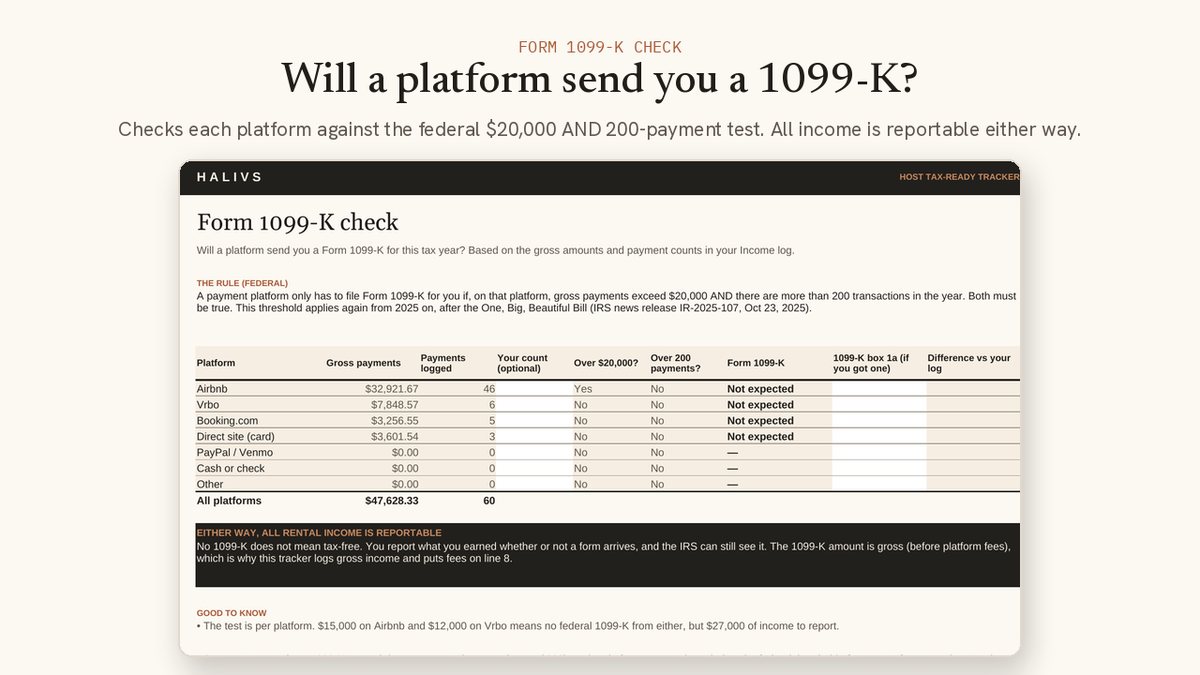
Form 1099-K is the information return payment platforms file to report what they paid you. After the One, Big, Beautiful Bill, a platform only has to file one if your gross payments on that platform exceed $20,000 and you had more than 200 transactions in the year. Both have to be true. The lower thresholds that were being phased in, down to $600, no longer apply at the federal level (IRS news release IR-2025-107, Oct 23, 2025).
- The test is per platform. $15,000 on Airbnb and $9,000 on Vrbo means no federal 1099-K from either, and $24,000 of rental income to report.
- States can be stricter. Some require a 1099-K at much lower amounts, and a platform can send one below the federal line. If one arrives, compare it with your own totals.
- Gross, not payout. A 1099-K shows gross payments before the platform’s fees, so your payouts will look smaller than the form. Airbnb explains its forms on its tax help page.
No form doesn’t mean no tax
A 1099-K is a reporting form, not the rule for what is taxable. Rental income is reportable whether or not a form arrives. Without one, your own records are the only record. That’s the part that goes wrong in January: payouts spread across two or three platforms, receipts in an inbox, and a cleaning bill nobody wrote down.
The Halivs Host Tax-Ready Tracker keeps those records in one spreadsheet for $19. More on it below.
Where rental numbers usually go
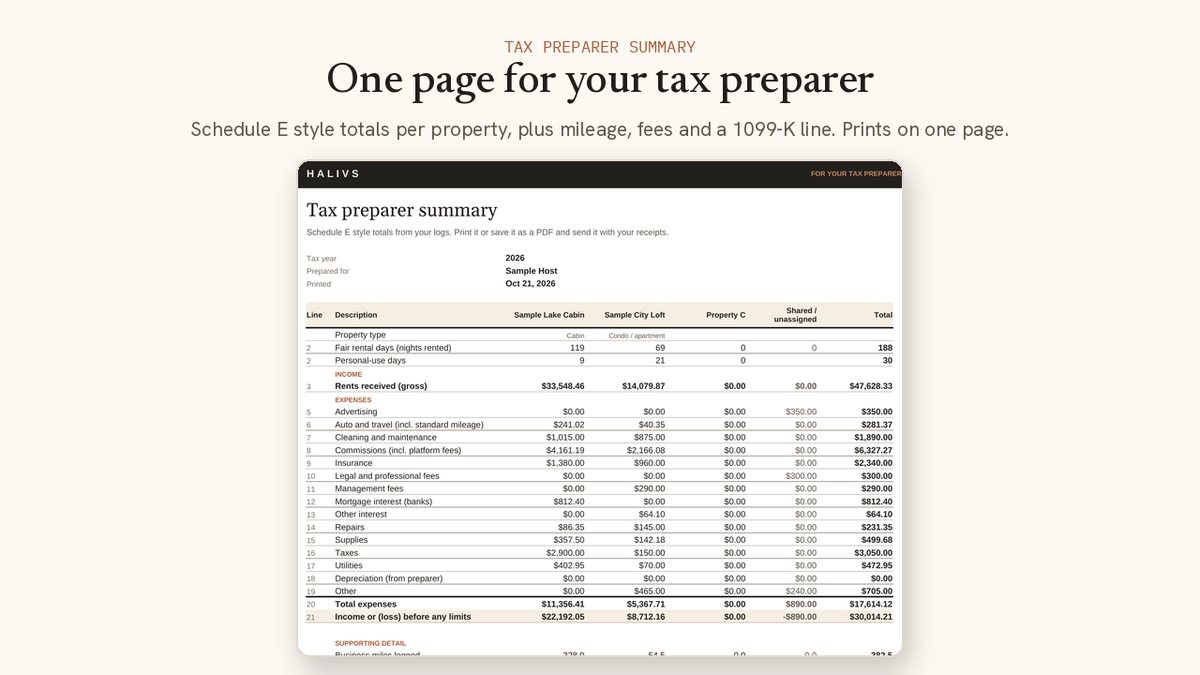
Most hosts who rent out a home report income and expenses on Schedule E (Form 1040), one column per property. The expense lines are fixed, so it helps to sort costs the same way all year:
- Advertising, auto and travel, cleaning and maintenance, commissions, insurance
- Legal and professional fees, management fees, mortgage interest, other interest
- Repairs, supplies, taxes, utilities, depreciation and other
Three situations change the picture, so flag them for your preparer: an average stay of 7 nights or less, hotel-like services such as daily cleaning or meals, and personal use of more than 14 days or 10% of the rented days. IRS Publication 527 covers the personal-use rules.
Mileage counts too
Trips for turnovers, repairs and supply runs add up. For 2026 the IRS business standard mileage rate is 72.5 cents a mile from January 1 to June 30 and 76 cents a mile from July 1 to December 31 (IRS standard mileage rates). Log the date, the property, the purpose and the miles.
A simple routine that holds up
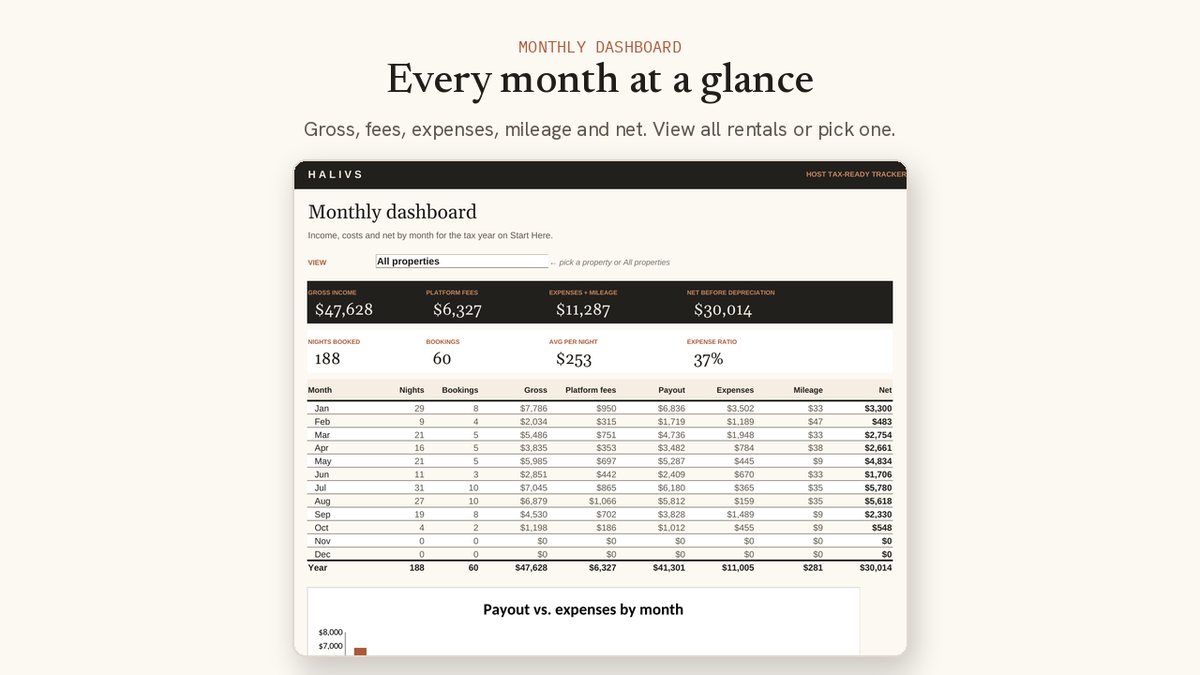
- Weekly: log each payout with the platform, gross, fees and nights.
- As you spend: log the cost under its Schedule E line and keep the receipt.
- After each trip: log the miles.
- In January: download each platform’s earnings report, compare it with your log and any 1099-K, and send your preparer one summary page.