No 1099-K from Airbnb? You still report the income.
The federal Form 1099-K threshold is back to more than $20,000 and more than 200 transactions per platform. Most hosts with one to three rentals won’t get a form this winter. The income still counts, and the records are on you.
By Halivs · Updated November 27, 2026
What changed with Form 1099-K
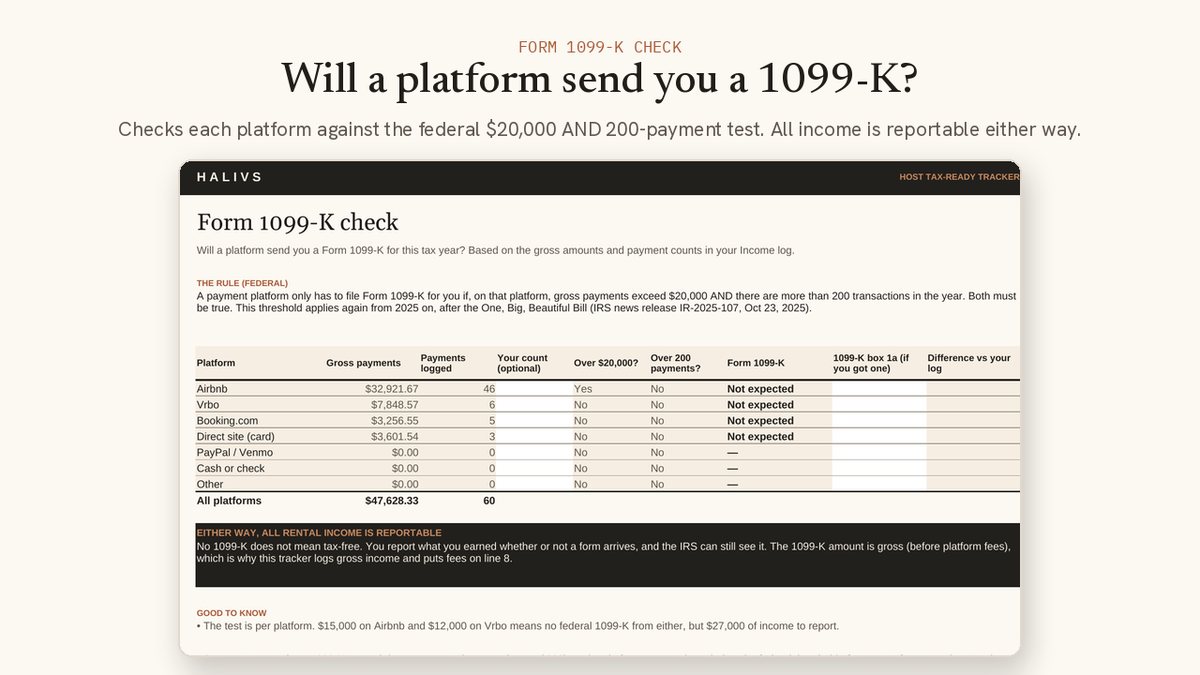
Form 1099-K is the information return payment platforms file to report what they paid you. After the One, Big, Beautiful Bill, a platform only has to file one if your gross payments on that platform exceed $20,000 and you had more than 200 transactions in the year. Both have to be true. The lower thresholds that were being phased in, down to $600, no longer apply at the federal level (IRS news release IR-2025-107, Oct 23, 2025).
- The test is per platform. $15,000 on Airbnb and $9,000 on Vrbo means no federal 1099-K from either, and $24,000 of rental income to report.
- States can be stricter. Some require a 1099-K at much lower amounts, and a platform can send one below the federal line. If one arrives, compare it with your own totals.
- Gross, not payout. A 1099-K shows gross payments before the platform’s fees, so your payouts will look smaller than the form. Airbnb explains its forms on its tax help page.
No form doesn’t mean no tax
A 1099-K is a reporting form, not the rule for what is taxable. Rental income is reportable whether or not a form arrives. Without one, your own records are the only record. That’s the part that goes wrong in January: payouts spread across two or three platforms, receipts in an inbox, and a cleaning bill nobody wrote down.
The Halivs Host Tax-Ready Tracker keeps those records in one spreadsheet for $19. More on it below.
Where rental numbers usually go
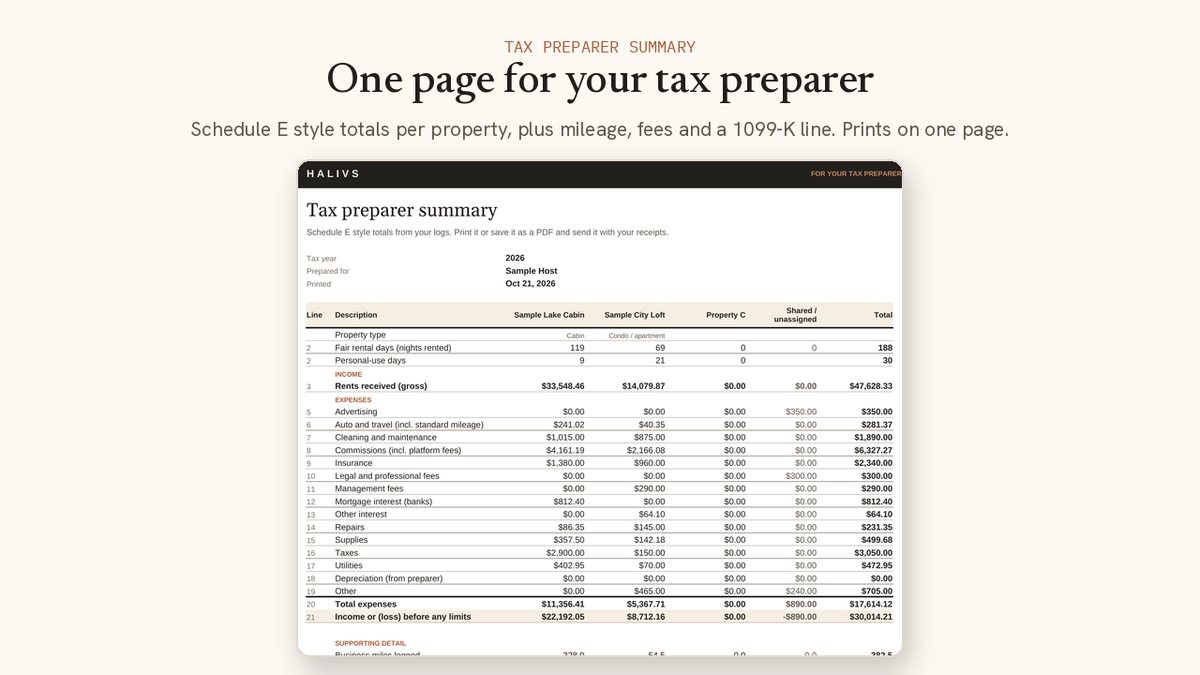
Most hosts who rent out a home report income and expenses on Schedule E (Form 1040), one column per property. The expense lines are fixed, so it helps to sort costs the same way all year:
- Advertising, auto and travel, cleaning and maintenance, commissions, insurance
- Legal and professional fees, management fees, mortgage interest, other interest
- Repairs, supplies, taxes, utilities, depreciation and other
Three situations change the picture, so flag them for your preparer: an average stay of 7 nights or less, hotel-like services such as daily cleaning or meals, and personal use of more than 14 days or 10% of the rented days. IRS Publication 527 covers the personal-use rules.
Airbnb host tax deductions 2026 (Schedule E list)
Hosts who search for write-offs usually want the same list Schedule E uses. Below is a plain-language map of the common lines for a dedicated short-term rental. It is a record-keeping checklist, not tax advice. Confirm every line with your preparer.
2026's biggest new line for many hosts: Airbnb's 15.5% host-only fee (US hosts from Sept 15, 2026; EEA/Swiss hosts from Oct 13). Report gross rents, then deduct the platform fee, usually as commissions, so your return matches a Form 1099-K. 2026 is a split year for US hosts: keep fees per booking, not one guessed percentage. See the 15.5% fee guide.
- Advertising — listing photos, paid boosts, a simple rental site, host-directory fees.
- Auto and travel — mileage or actual car costs for turnovers, repairs and supply runs; overnight travel when the trip is mainly for the rental.
- Cleaning and maintenance — turnover cleaners, laundry, yard work, routine upkeep.
- Commissions — Airbnb, Vrbo and Booking.com host fees; co-host or manager cuts paid out of your payout.
- Insurance — homeowners, STR or liability policies on the rental.
- Legal and professional fees — tax prep, attorney, bookkeeper for the rental.
- Management fees — property manager or full-service co-host invoices.
- Mortgage interest — interest on the rental loan (not principal).
- Other interest — interest on loans used for the rental (ask your preparer).
- Repairs — fixing what broke (faucet, window, touch-up paint). Restoring, not upgrading.
- Supplies — toiletries, paper goods, linens, small guest amenities, cleaning products.
- Taxes — property taxes on the rental; lodging tax you paid out of pocket when that applies.
- Utilities — electric, gas, water, trash, internet and guest streaming you provide.
- Depreciation — building (typically 27.5 years for residential rental) and shorter lives for furniture and appliances. Your preparer runs the numbers.
- Other — HOA or condo dues, software for hosting, education tied to the rental, and similar ordinary costs.
Usually not an immediate write-off: capital improvements that add value or extend life (new roof, full remodel, new HVAC on a residential rental) are depreciated, not expensed in one year. Mortgage principal is not an expense. Personal-use days reduce the share you can claim — see Publication 527.
The Host Tax-Ready Tracker ($19) logs each cost under these Schedule E lines and prints one summary page for your preparer. Excel and Google Sheets.
Mileage counts too
Trips for turnovers, repairs and supply runs add up. For 2026 the IRS business standard mileage rate is 72.5 cents a mile from January 1 to June 30 and 76 cents a mile from July 1 to December 31 (IRS standard mileage rates). Log the date, the property, the purpose and the miles.
A simple routine that holds up
- Weekly: log each payout with the platform, gross, fees and nights.
- As you spend: log the cost under its Schedule E line and keep the receipt.
- After each trip: log the miles.
- In January: download each platform’s earnings report, compare it with your log and any 1099-K, and send your preparer one summary page.
Airbnb host year-end checklist (do this in December)
December is the easiest time to close out the year: bookings are slower, and January's forms and preparer questions haven't started yet. Work down this list once for each property. It is a record-keeping checklist, not tax advice.
- Download your 2026 reports. Get the earnings or transaction report from Airbnb, Vrbo and Booking.com for the year so far, then pull them again in January for the last weeks of December.
- Match payouts to bank deposits. Tick each payout against your bank statement and note anything missing, held or refunded.
- Gather receipts by Schedule E line. Sort them into the same categories as the list above: cleaning, supplies, repairs, utilities, commissions and the rest.
- Total your mileage. Add up turnover, repair and supply trips. Trips through June 30 use 72.5 cents a mile and trips from July 1 use 76 cents, so keep the two halves apart.
- Count personal-use days and rental days. Write down both numbers for each property. Personal use of more than 14 days or 10% of the rented days changes the picture, so flag it for your preparer.
- Check which platforms might send a 1099-K. The federal threshold is more than $20,000 and more than 200 transactions per platform. Note which platforms you came close on, and keep your own totals either way.
- List big purchases and repairs. Write down the date, cost and what it was for anything large (furniture, appliances, a new roof). How it is depreciated is your preparer's call.
- Read the year's guest reviews. Find the complaint that came up most often and fix it before your next busy season.
- Refresh your listing for 2027. Retake or re-edit the photos that look dated and update the title for what guests actually book you for.
- Book your tax-preparer appointment now. Preparers fill up early in the new year. Ask what format they want your summary in.
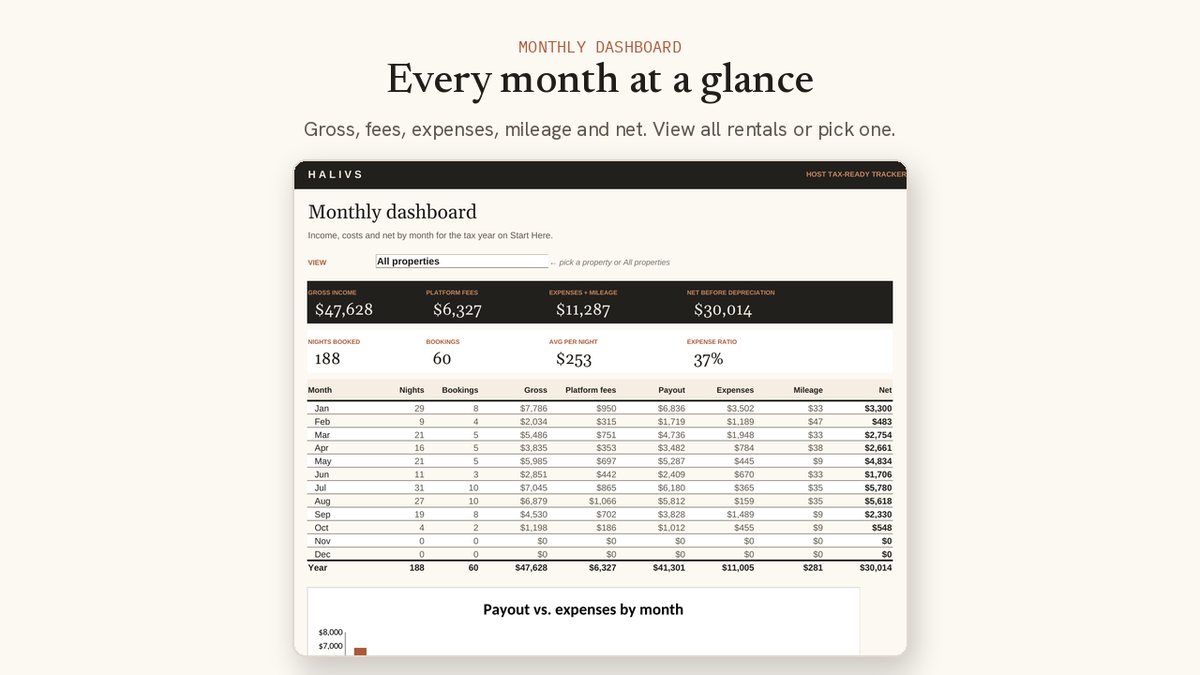
The Host Tax-Ready Tracker ($19) covers most of this list in one file: payouts by platform, expenses by Schedule E line, mileage at both 2026 rates, a 1099-K check and personal-use flags, with one summary page for your preparer. Excel and Google Sheets.
Includes a free 2027 edition: we'll add it to your download once the IRS publishes the 2027 mileage rates (usually late December).
Rather not redo the photos and title yourself? The $39 Listing Refresh polishes 5 of your listing photos and rewrites the title for you.