
Airbnb slow-season pricing after the 15.5% fee: discounts, minimum nights and Black Friday
The slow season is when pricing mistakes cost the most. Since the switch to Airbnb’s single 15.5% host fee, every discount comes straight out of your payout, so a sale that used to feel small now takes a real bite. This guide gives you a floor price worksheet, the math for whether a discount pays for itself, a discount ladder, minimum-night rules for gap nights, a plan for Black Friday and Cyber Monday, and messages you can copy that stay inside Airbnb’s rules.
By Halivs · Updated November 19, 2026 · Sources linked throughout · Not tax or legal advice
What changed for slow-season pricing in 2026?
Two things. First, the fee. Most hosts now pay Airbnb’s single host-only fee of 15.5% (16% in Brazil and Mexico) on the nightly price and on any fees they add, and guests no longer pay a separate Airbnb service fee. US hosts moved by September 15, 2026, and hosts in the EEA and Switzerland by October 13 (Airbnb). If your base price is $120, you keep about $101 of it before your own costs. A 20% discount on that night leaves you about $81.
Second, the tools. Airbnb added several pricing settings in 2026 that matter most when bookings slow down:
- Seasonal prices. Set a different base price for each month and a weekend adjustment, like +15% (The right price for every season).
- Last-minute settings. Allow shorter stays for unbooked nights within 2 weeks of check-in, and step up last-minute discounts for guests booking 8–14, 2–7 and 0–1 days ahead. These started rolling out in July and August 2026 and are reaching all hosts over the coming months (Review your price).
- Dynamic pricing. A suggested price range that adjusts daily, which started rolling out in October 2026.
- Top-rated guests discount. 15% off for guests rated 4.8 or higher with at least 3 reviews. It can combine with one other discount (Airbnb Help Center).
Airbnb’s own data says listings whose prices were updated at least four times a year had over 30% more nights booked than those that weren’t (Controlling your pricing). So the slow season is a reason to check prices more often, not just to cut them once.
What is the lowest price you should accept in the off season?
Start with a floor: the lowest nightly price at which a booked night is still worth it. Hosts who price well tend to talk about it this way. On r/ShortTermRentals, one host put it simply: “set a floor below which it’s not worth it to book and stick with it”, and count “the cost of attracting bad guests” too (Reddit thread). A Palm Springs Superhost quoted by Airbnb said the same: “I do have a minimum price, so I’ll never go below that” (Six ways to prepare for low season).
Copy this worksheet, or download the free spreadsheet version, which does the math for you:
SLOW-SEASON FLOOR WORKSHEET (one per listing)

A. Costs for each booked night (not paid by the cleaning fee):
   utilities used per night ............ $____
   supplies per night (coffee, soap) ... $____
   other per-night costs ............... $____
   A = total ........................... $____

B. Costs for each stay the cleaning fee doesn't cover
   (laundry service, restock, extra cleaner pay) $____
   divided by your usual nights per stay ____  = B $____

C. The least you want to keep for a booked night
   (wear and tear, your time; your choice) .... C $____

FLOOR (lowest nightly price) = (A + B + C) / 0.845

Example: A $18 + B $6 + C $25 = $49 / 0.845 = $58 a night.
Never let a discount take the price guests pay below this.
Dividing by 0.845 adds back Airbnb’s 15.5%. Leave out costs you pay whether or not anyone books, like the mortgage or insurance. They matter for the year, but they don’t change whether one extra booking is worth taking. Your cleaning fee should cover the clean itself; the cleaning fee guide shows how to set it after the fee change. Airbnb also has a hard limit: after discounts, your price must be at least $10 a day (Help Center).
How many more bookings does a discount need to pay for itself?
More than most people expect, because the 15.5% fee and your per-night costs don’t shrink when the price does. Here is the formula and a worked example:
EXTRA BOOKINGS A DISCOUNT NEEDS TO PAY FOR ITSELF

net per night = price x 0.845 - A (your per-night costs)
extra nights needed = (net at full price / net at discounted price) - 1

Example: $150 a night, A = $20, 15% off
full price:  150.00 x 0.845 - 20 = $106.75
discounted:  127.50 x 0.845 - 20 =  $87.74
106.75 / 87.74 - 1 = 0.217 -> about 22% more booked nights
(10 booked nights a month would need to become about 12)
| Discount | $120 night, $15 costs | $150 night, $20 costs | $200 night, $30 costs |
|---|---|---|---|
| 5% | $81.33 net · +6% | $100.41 net · +6% | $130.55 net · +6% |
| 10% | $76.26 net · +13% | $94.08 net · +13% | $122.10 net · +14% |
| 15% | $71.19 net · +21% | $87.74 net · +22% | $113.65 net · +22% |
| 20% | $66.12 net · +31% | $81.40 net · +31% | $105.20 net · +32% |
| 25% | $61.05 net · +42% | $75.06 net · +42% | $96.75 net · +44% |
Read it like this: on a $150 night with $20 of per-night costs, a 15% discount needs about 22% more booked nights to earn the same money. If those nights would have stayed empty anyway, the discount is pure gain. If they would have sold at full price, it is pure loss. That is why the rest of this guide targets empty dates, not the whole calendar. Numbers are rounded; your own costs will change them.
Which Airbnb discounts work best in the slow season?
Here is every discount Airbnb offers homes in 2026, with the limits that matter in a quiet month:
| Discount | What it does | When guests see a callout | Watch out for |
|---|---|---|---|
| Weekly / monthly | Off stays of 7+ or 28+ nights; custom lengths with rule-sets | 10% or more | Must follow local stay limits. Overrides Smart Pricing. |
| Last-minute | Off bookings made 1–28 days before check-in | 10% or more off your 60-day median price | Can attract the lowest-paying guests; keep it above your floor. |
| Custom promotion | Your chosen % off chosen dates | 15% or more | Needs 3+ bookings (1 in the past year); dates less than 90 days away and open for 28 days; only half the nights in a month. |
| Early bird | Off bookings made 1–24 months ahead | 3% or more | Not available with Smart Pricing on. |
| New listing promotion | 20% off until 3 reviews or 10 bookings | Always | Needs fewer than 3 reviews and Smart Pricing off. |
| Top-rated guests | 15% off for guests rated 4.8+ with 3+ reviews | Airbnb says it helps you show up in more searches | Combines with one other discount. |
| Non-refundable | 10% off if the guest picks a non-refundable rate | In the guest’s rate choice | Applied after all other discounts. |
Sources: Controlling your pricing, Six ways to prepare for low season, Turning high demand into high earnings, custom promotion requirements, new listing promotion. Discounts of 20% or more may also get your listing into Airbnb’s emails to guests who recently searched your area.
Only one discount applies per night
If you set several for the same dates, Airbnb applies just the highest-priority one: new listing promotion, then custom promotion, then length-of-stay, then early bird, then last-minute (Combining discounts and rule-sets). So a 20% custom promotion on dates that also have a 30% monthly discount gives a month-long guest 20%, not 30% and not 50%. Two traps: Airbnb says a discount can push the guest’s price below your Smart Pricing minimum, and custom promotions are based on your 60-day median price, capped at the highest price you were booked at in the past year (Help Center). Raising prices just before a sale doesn’t make the discount look bigger.
What discount ladder should you use as dates get closer?
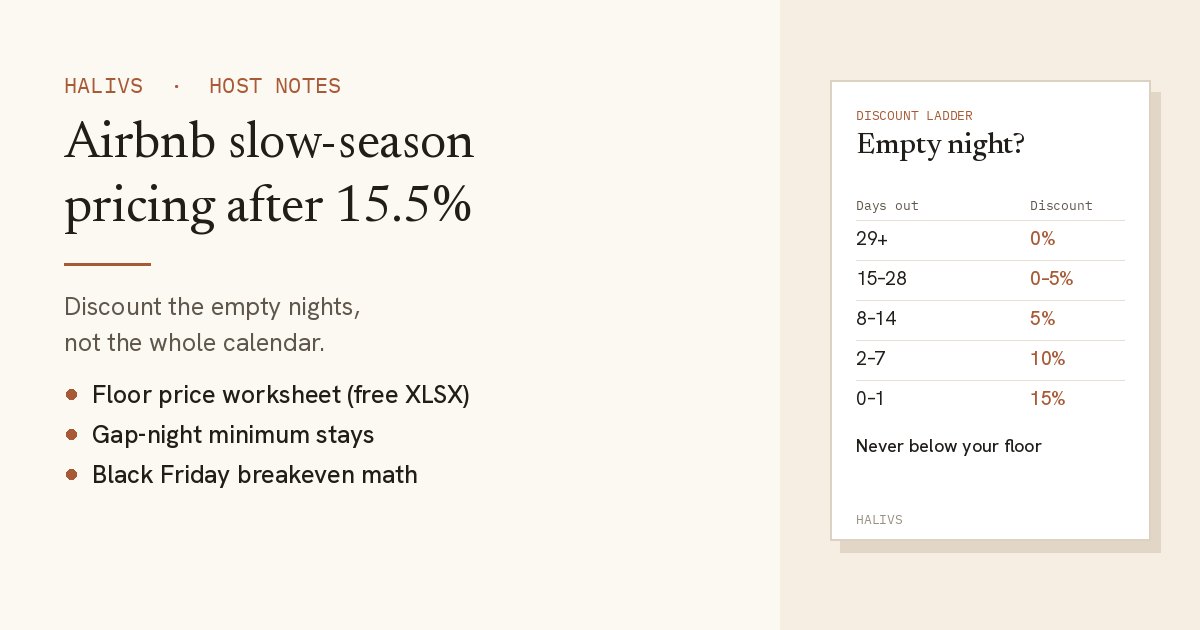
A ladder lowers the price in small steps as an empty night gets closer, instead of one big cut. Airbnb’s new last-minute settings use the same three windows, so you can copy this straight in. The percentages are a starting point, not a rule. Adjust them to your market and never go below your floor.
| Days before check-in | Discount to try | Minimum nights | Why |
|---|---|---|---|
| 29+ days | 0% (seasonal price only) | Your normal minimum | Plenty of time; let the seasonal price work. |
| 15–28 days | 0–5%, or a weekly discount only | Normal | Check your booking pace against similar listings first. |
| 8–14 days | 5% | Allow 2 nights midweek | Shorter stays now open within 2 weeks of check-in. |
| 2–7 days | 10% | Allow 1–2 nights | 10% is where the crossed-out price appears. |
| 0–1 days | 15%, or down to your floor | 1 night | An empty night earns nothing; the floor protects you. |
How fast to step down? One host on r/ShortTermRentals passed on a rule of thumb: find your average booking lead time, and if you are not at least 50% booked by then, start lowering prices. Another compares their occupancy with the local market: if everyone is slow, being fully booked may just mean giving away margin (Reddit thread). Some hosts turn off automatic last-minute drops entirely because “my worst guests have been the ones who pay the least”. If that is your experience, stop the ladder at 10% and keep Instant Book requirements tight.
What minimum-night rules fill gap nights?
A 2- or 3-night minimum that makes sense in summer leaves single nights stranded between winter bookings. Airbnb lets you set the minimum by check-in day, for example 2 nights for a Friday check-in and 1 night on other days (Help Center), and its last-minute settings can allow shorter stays only for unbooked nights within 2 weeks (Airbnb). Hosts using professional tools can also set trip lengths and check-in days in rule-sets (rule-sets).
| Gap between bookings | Minimum to allow | Price move |
|---|---|---|
| 1 night | 1 night, for that night only | Last-minute discount if it is within 7 days; keep the full cleaning fee. |
| 2 nights | 2 nights | Normal ladder. |
| 3–6 nights | 2 nights midweek, your normal weekend minimum | Normal ladder; consider a small discount for 3+ nights. |
| 7–27 nights | Normal | Weekly discount of 10%+ does the work. |
| 28+ nights (the whole month) | Normal, or 28 nights for a monthly-stay test | Monthly discount; check local rules on long stays. |
Felicity, a Superhost in Sydney quoted by Airbnb, put it this way: “During the slower periods, I will definitely reduce my minimum night stay and that helps me attract people who are maybe just coming through for a few nights” (Finding success when it’s slow). One-night stays mean a full clean for one night, so your cleaning fee has to stay in place. Your minimum and maximum stays also have to follow local rules (Airbnb).
Should you run a Black Friday or Cyber Monday discount?
Guests are primed to look for deals from Black Friday (November 27, 2026) through Cyber Monday (November 30), and a custom promotion of 15% or more gets a callout in search. But a discount on nights that would have sold anyway is just lost money. A revenue-management firm that writes about this puts it plainly: discount by confirmed gap, not by date range (Revenuenaire, Oct 2026). If you do run one:
- Pick the dates first. Open nights in early December, January and February that are still empty, not Thanksgiving week, Christmas, New Year’s Eve or local event weekends. (For NYE, the party prevention guide matters more than price.)
- Check the custom promotion limits. Your listing needs at least 3 bookings with one in the past year, the dates must be less than 90 days away and have been open for 28 days, and you can promote only half the nights in any month (Help Center). From November 27, 90 days reaches about February 25.
- Prefer a longer-stay deal. A weekly discount or a 3-night package fills more nights per clean than a flat cut on one-night stays.
- Check it against your floor with the breakeven table above. A 15% deal needs about a fifth more booked nights to break even.
- Keep channels the same. Vrbo’s new host terms include a rate-parity clause covering your own website too (The Host Report), so match the deal everywhere you list.
- Turn it off on Tuesday. Set a reminder to end the promotion after Cyber Monday so it doesn’t quietly run on nights that would sell.
The 2026 holiday calendar: what to discount and what not to
- Thanksgiving (Thursday, November 26). PriceLabs describes the typical trip as four nights, Wednesday to Sunday (November 25–29). A minimum stay longer than four nights can block it, and a long minimum can strand the Monday and Tuesday before. Allow shorter stays on those two nights or price them to sell, and save last-minute discounts for the final week (PriceLabs).
- Christmas and New Year’s Day both fall on a Friday. That makes two long weekends, December 25–27 and January 1–3, which are likely to sell at full price. Keep them out of any Black Friday or Cyber Monday deal. PriceLabs says the US average nightly rate in December 2025 was 17% higher than in November (PriceLabs).
- The nights at risk are Monday 28 to Wednesday 30 December. The typical US December stay was five nights. Set minimum stays on the two long weekends close to that early on, shorten them as arrival gets closer, and let gap nights sell at their real length (PriceLabs).
- January is where a deal earns its keep. In PriceLabs data, January 2026 had 44% occupancy, the lowest of any month from October 2025 to September 2026. Point a Black Friday promotion there.
Can you message past guests about open dates?
This is where many slow-season tips get hosts in trouble. Airbnb’s Terms of Service say: “Do not use the Airbnb Platform, our messaging tools, or Members’ personal information to send commercial messages without their express consent.” Its pricing and payment transparency policy keeps payments for future and repeat bookings on Airbnb, bans links that take guests off the platform, and bans offering discounts to book off Airbnb. And from November 20, 2026, hosts generally can’t ask guests for contact details such as an email address during the booking or stay (Help Center).
So skip the “message every past guest a 20% code” idea. These messages stay within the rules: they answer a guest who wrote first, use Airbnb’s own tools, or go only to people who signed up for your own list. Swap the [brackets] for your details.
1. Special offer reply (guest asked about dates or price)
A special offer lets you set a total price for a guest who messaged you before booking. The price should include cleaning; the guest has 24 hours to accept.
[Use this only as a reply to a guest who messaged you first, then send it as an Airbnb special offer.]

Hi [Name], thanks for asking about [dates].

Those nights are open. I've sent you a special offer here on Airbnb for [number] nights at [total price] in total, including the cleaning fee. It's [about X% / $X] less than the listed price, because it's a quieter time of year for us.

The offer is good for 24 hours. If it doesn't fit, tell me what would and I'll see what I can do.
2. Long-stay or monthly inquiry
[Reply to a guest who asks about a long or monthly stay.]

Hi [Name], thanks for your message. A [two-week / month-long] stay works well here.

For [dates], the weekly / monthly discount on the listing brings the total to [total] for [nights] nights, including cleaning. That's about [$ per night] a night.

The listing has [desk / fast WiFi speed / washer] for longer stays. Everything we ask of guests is in the house rules on the listing. Nothing extra is added after you book.

Happy to answer anything else before you book.
3. Current guest asks to stay longer
Extensions must go through Airbnb’s change reservation tool, not cash or a payment app (Airbnb).
[Reply to a guest who is staying now and asks to stay longer.]

Hi [Name], glad you're enjoying it! [Night(s)] are open, so yes, you can stay longer.

I'll send a change request through Airbnb for the extra [number] night(s) at [price] a night. Once you accept it, your checkout moves to [new date] and everything else stays the same.
4. A guest asks about coming back
[Reply when a past or current guest asks you about coming back.]

Hi [Name], that's great to hear, we'd love to have you back.

[Month] is usually quieter here, so the prices on the listing are lower then, and stays of 7 nights or more get the weekly discount. If you message me here on Airbnb with dates, I can check them and send you an offer.
5. Email to your own opt-in list (not Airbnb guests)
If you have a direct-booking website, people who sign up there are your list. Never add guests using contact details you got through Airbnb. In the US, the CAN-SPAM Act requires a subject line that isn’t misleading, a valid postal address, a working way to opt out, and that you stop emailing anyone who opts out within 10 business days.
[Only for people who signed up for emails on your own website or booked directly with you, never contact details from Airbnb. Follow the email rules where you live.]

Subject: Quiet weeks at [Home name] this winter: [X]% off [dates]

Hi [First name],

You're getting this because you signed up for news from [Home name] at [your website].

We have open dates from [date] to [date]. Stays of [3+] nights in that window are [X]% off when you book on [your website] by [date].

[One line about what's good in the off season: fireplace, empty beaches, ski deals nearby.]

Check dates: [link to your own booking page]

[Your name], [Home name]
[Mailing address]
Don't want these emails? Reply "unsubscribe" or click here: [link]
What fills slow weeks besides a lower price?
- Longer stays. Hosts on r/airbnb_hosts describe aiming slow months at remote workers, traveling professionals, snowbirds and contract workers with stronger weekly and monthly discounts (thread 1, thread 2). A monthly stay also means one clean instead of several. Stays of 28+ nights may also get Airbnb’s Monthly Stay Savings, which Airbnb pays for, not you (Help Center).
- A listing that fits the season. A summer first photo in January looks out of date. Lead with the fireplace, the workspace or the winter view, and rewrite the first lines of the description. See how to write a listing title and description and editing listing photos accurately.
- A fresh pair of eyes. Price is not always the problem. A host in England wrote that she had lowered her price and allowed one-night stays for November and still had nothing (Reddit). Our free listing check is a short written review of your photos, title and opening lines.
- A short checkout list. Airbnb says guests prefer a short checkout list and that more guests book listings with checkout instructions (Airbnb). Under the November 20 rules, those instructions can’t include cleaner chores anyway: see Airbnb’s new house rules.
- Maintenance while it’s quiet. Block a few low-demand days for repairs and winter prep using the winter checklist.
What should be on your slow-season pricing checklist?
- ☐ Write down your floor for each listing with the worksheet above, and set your Smart Pricing minimum (if you use it) high enough that your biggest discount still stays above it.
- ☐ Check that your prices already include the 15.5% fee change. If you never repriced, fix that first with the 15.5% repricing guide.
- ☐ Set seasonal prices by month (or one lower base price for the slow months), plus a weekend price.
- ☐ Open the similar listings map for your slow weeks and compare booked and unbooked homes, not just the cheapest ones.
- ☐ Turn on a weekly discount of at least 10% (that is the callout threshold) and a monthly discount that still clears your floor.
- ☐ Set last-minute discounts in steps for 8–14, 2–7 and 0–1 days before arrival, never below the floor.
- ☐ Allow shorter stays midweek and for gap nights within 2 weeks of check-in. Keep weekend minimums.
- ☐ Check that your minimum and maximum stays follow local rules (some cities set minimum stays).
- ☐ Mark holidays and local events and keep them at full price.
- ☐ If you run a Black Friday or Cyber Monday promotion, put it on open dates less than 90 days out, and turn it off when it ends.
- ☐ Use the same discount on Vrbo and your own site if you list there too.
- ☐ Refresh the first photo, the title and the first lines of the description for the season.
- ☐ Keep house rules, checkout steps and fees the same as the listing. No new rules, fines or chores after booking.
- ☐ Log each booking’s price, discount, fee and payout so you can see what the slow season really earned.
Track it as you go. When the season ends, you want to see each booking’s price, the discount, Airbnb’s fee and your payout side by side, so next year’s floor is based on real numbers. Fees are generally a deductible rental expense too; the tax tracker guide explains how to record gross, fee and payout for each booking.
Questions hosts ask
When is the Airbnb slow season?
It depends on your market. Beach and summer towns slow down from fall to early spring, ski towns slow down in spring and fall, and many cities are quiet from January to March. Look at last year’s calendar and at the similar listings map in your Airbnb calendar, which shows the average prices of booked and unbooked homes near you for dates up to 31 days long.
Should I lower my nightly price or add a discount?
For a whole season, lower the base price by month with Airbnb’s seasonal price settings. For specific empty dates, a discount is usually better: weekly and last-minute discounts of 10% or more show a crossed-out price in search, and a custom promotion of 15% or more gets a special callout. Either way, keep every price above your floor.
Do Airbnb discounts stack?
Mostly no. Only one of these applies per night: new listing promotion, custom promotion, length-of-stay discount, early bird discount and last-minute discount, in that order of priority. The top-rated guest discount can combine with one of them, and the 10% non-refundable discount is applied after the others.
Can my price go below my Smart Pricing minimum?
Yes. Airbnb says that if you add a discount, such as an early bird discount, the price guests pay may go below the minimum you set in Smart Pricing. Weekly, monthly and trip-length discounts also override Smart Pricing. Set your Smart Pricing minimum high enough that your biggest discount still lands above your floor.
Can I message past Airbnb guests about a slow-season discount?
Not as a marketing blast. Airbnb’s Terms say not to use its messaging tools or members’ personal information to send commercial messages without their express consent, and its payments policy bars offering discounts to book off Airbnb. Reply when a guest asks first, use a special offer, and only email people who signed up for your own list.
Is a Black Friday discount worth it for an Airbnb?
Only on dates that are likely to stay empty. With the 15.5% fee and your per-night costs, a 15% discount on a $150 night with $20 of costs needs about 22% more booked nights just to earn the same. Skip holiday weekends and local event dates, and aim the discount at open weeks in December, January and February.
Should my Airbnb Black Friday discount include Christmas or New Year dates?
Usually not. In 2026 Christmas Day and New Year’s Day both fall on a Friday, which creates long weekends on December 25–27 and January 1–3 that are likely to sell at full price. PriceLabs data shows December nightly rates were 17% higher than November last year, while January had the lowest occupancy (44%). Aim a Black Friday deal at empty January and February dates instead.
Should I change my cleaning fee in the slow season?
Most hosts keep the cleaning fee and change the nightly price, because the fee pays for a real clean. If short stays are the problem, a lower nightly price for longer stays or a weekly discount spreads that one clean over more nights. The cleaning fee guide shows how to set it after the 15.5% fee.
Sources: Airbnb host-only fee (Help Center 1857), Airbnb: simplifying service fees, Airbnb: review your price, Airbnb: six ways to prepare for low season, Airbnb: controlling your pricing, Airbnb: finding success when it’s slow, Airbnb: the right price for every season, Airbnb: turning high demand into high earnings, Airbnb: combining discounts and rule-sets, Help Center 3421: discounts and promotions, Help Center 2720: custom promotion requirements, Help Center 2719: median price, Help Center 1233: weekly and monthly discounts, Help Center 1168: Smart Pricing, Help Center 880: minimum nights, Help Center 2061: rule-sets, Airbnb: new listing promotion, Help Center 35: special offers, Airbnb Terms of Service, Airbnb pricing and payment transparency policy, Airbnb contracts and personal data policy, Airbnb house rules policy, The Host Report: Vrbo 12% and rate parity, CAN-SPAM Act, 15 U.S.C. 7704, Revenuenaire: Black Friday breakeven guide, r/ShortTermRentals: when to lower prices, r/airbnb_hosts: surviving the low season, r/airbnb_hosts: bookings slump, r/AirBnB: no bookings for November. PriceLabs: Thanksgiving 2026 pricing plan, PriceLabs: Christmas 2026 minimum stays and gap nights (fetched November 19, 2026). Others fetched November 17, 2026. Halivs makes templates and tools for hosts; it is not a revenue manager, tax adviser or law firm, and this page is not tax or legal advice.